

This article is adapted from a sermon I recently shared with the congregation I pastor at Albemarle First Assembly in North Carolina. We’re in the middle of a series of conversations I’m calling “Dear Church,” where I’m asking us to take an honest look at who we are becoming as followers of Jesus. While I originally wrote these words for my own church family, I think the questions are worth asking well beyond our congregation. Maybe they’re questions for all of us.
I love mowing the yard.
I know that’s probably strange to some people, but I genuinely enjoy it. There’s something deeply satisfying about starting with a mess and finishing with something that looks better. You can see what you’ve accomplished. There’s a beginning, an end, and some visible evidence that your work mattered.

I like accomplishing things.
And if I’m being truthful, that instinct follows me into my work as a pastor.
I love seeing things happen. I love it when a project comes together, when we accomplish a goal, when something we’ve worked toward for months finally becomes reality.
Our church recently received a significant grant for campus improvements. We have a thriving preschool ministry. We’ve been navigating major financial and organizational challenges, and we are finally seeing encouraging signs of progress. I’m grateful for all of it.
But there’s a question I keep coming back to, and it won’t leave me alone:
Are we becoming the people these ministries exist to help us become?
Because we don’t need to be busier.
We need to be formed in the likeness of Jesus.
We Know How to Build Things
Years ago, while interviewing for a pastoral position, I was asked a question pastors are probably supposed to have a really impressive answer for.
“What’s your vision?”
I didn’t have one.
Well, not the kind they were looking for, anyway.
I could talk about loving people, shepherding a congregation, making disciples, and helping people become more like Jesus. But I didn’t have some grand organizational blueprint or a five-year plan to build something impressive.
I think they were disappointed.
I understand why. We like vision. We like progress. We like knowing where we’re going and how we’ll measure whether we’ve arrived.
And none of that is necessarily bad.
But it’s much easier to measure attendance, giving, building projects, and program participation than it is to measure whether we’re becoming more patient, generous, honest, forgiving, and welcoming.
Oddly enough, those interview questions have never ventured into my prayer life. I’ve never been asked about my prayer life by a board, a search committee, or a church official.
That tells me something about church leadership. We may not be very focused on prayer, but we know how to count people in a room.
It’s much harder to know whether the people in that room are learning to love their enemies. We can build something together without allowing God to build something in us. That ought to trouble us.
Think about a family for a moment. They can keep every appointment, pay every bill, get everyone to practice on time, and maintain a beautifully organized calendar.
And still barely know what’s happening in one another’s lives. Everything can be running smoothly while the relationships themselves are starving. I wonder how often we do the same thing in church.
When Good Things Become Excuses
In Luke 14, Jesus tells a story about a man who prepares a great banquet. The invitations have gone out, food is ready, and the table is set. But when the servant goes to tell the invited guests that it’s time to come, something remarkable happens.
They start making excuses. One has purchased property and needs to inspect it. Another has bought oxen and wants to try them out. Another has just gotten married.
One by one, they decline the invitation.
Here’s what strikes me about this story: None of their excuses are particularly scandalous. They aren’t out committing terrible sins. They aren’t doing anything we would ordinarily condemn. They’re doing good things.
They’re tending to property, managing their livelihoods, and investing in family. Good things. Important things. Things that deserve their attention. Those good things have become their reasons to say no.
Their lives are so full of legitimate responsibilities that they have no room left to respond to the invitation. I wonder how often that’s us. We can stand in worship while resisting surrender. We can attend a small group while keeping everyone at a safe distance. We can serve faithfully in ministry while refusing to deal with the resentment we’ve been carrying for years. We can get excited about what’s happening on the church calendar, celebrate another successful event, or reach another financial goal—all while sending our regrets to God’s invitation.
We are busy with good things. But are we available to God?
I’ve come to believe that sometimes a full schedule is one of the best ways to protect ourselves from the uncomfortable work of spiritual formation. Because staying busy feels productive. Forgiving someone who hurt us? That’s hard. Admitting we’ve been wrong? Harder still. Slowing down long enough to recognize what God might be saying to us? For some of us, that’s almost unbearable.
So we keep moving, and we call it faithfulness.
Maybe the Invitation Isn’t to Do More
This is where I want to be especially careful. I’m not suggesting that people should neglect their families, abandon their responsibilities, or feel guilty because they’re exhausted. Some people are carrying more than anyone realizes. The last thing they need is another pastor telling them to do more.
In fact, I wonder whether the invitation of Jesus might be exactly the opposite. Maybe the next step in your discipleship isn’t another commitment. Maybe it’s surrender.
Maybe you’re willing to attend another Bible study, but you’ve been avoiding the apology you know you need to make. Jesus is waiting for you in that conversation.
Maybe you’re always available to volunteer, but you’re afraid to admit that you’ve reached your limits. Perhaps the invitation is to rest. To stop trying to do everything. To trust that the world—and even the church—will keep turning without your constant attention.
Maybe you want God to use you in some significant way, but you keep overlooking the person right in front of you because their need has arrived at an inconvenient time. What if that’s the invitation? The things we own, the jobs we have, the families we’ve been given, the responsibilities we carry—these are gifts.
What a tragedy it would be if God's very blessings became so important to us that we could no longer hear his voice.
There’s Still Room at the Table
The story Jesus tells doesn’t end with the excuses. When the invited guests refuse to come, the host sends his servant into the streets and alleys to bring in people who would never have expected an invitation to such a banquet: the poor, the overlooked, the people who don’t usually make it onto the guest list.
When the servant returns, he tells the host there’s still room. So the host sends him out again. Farther this time. Into the country roads. Bring them in. Fill the house.
I love this part of the story. The original guests' refusal doesn’t end the host's generosity. It reveals just how far his generosity is willing to reach.
Notice something else: The servant doesn’t get to decide who deserves an invitation. His job is to carry it. God sets the table. His servant carries the invitation.
The Old Testament scholar Christopher J. H. Wright once wrote:
“It is not so much the case that God has a mission for his church in the world, as that God has a church for his mission in the world.”
I think we need to hear that. The church doesn’t exist simply to maintain itself, preserve its traditions, or build an organization that impresses people. We exist to participate in what God is already doing in the world. Our preferences cannot become the boundaries of his welcome.
It’s easy to say we want more people to come to church. But who are we actually willing to welcome? Who would we have to make room for if God himself set the focus for our marketing (or passed out the invite cards)?
Not just people who look like us, think like us, vote like us, or already know how to behave in church. Everybody.
Welcoming somebody means more than finding an empty chair. Think about what happens when an unexpected guest arrives at a family dinner. Somebody has to move over. Somebody shares the food. Somebody starts a conversation. Somebody makes sure the newcomer doesn’t feel like an interruption.
Real hospitality changes the people who are already at the table.
I think that’s part of what Jesus is trying to teach us.
What Kind of People Are We Becoming?
There’s a contrast in this story that I don’t want us to miss. The invited guests arrange the invitation around their existing priorities. The servant allows the host’s priorities to direct his movements. That’s a discipleship question.
Will we keep trying to fit Jesus around the life we’ve already arranged? Or will we allow him to reshape how we live?
At our church, we’ve been talking about discipleship in three simple movements: Planted. Growing. Welcoming. I think they fit here.
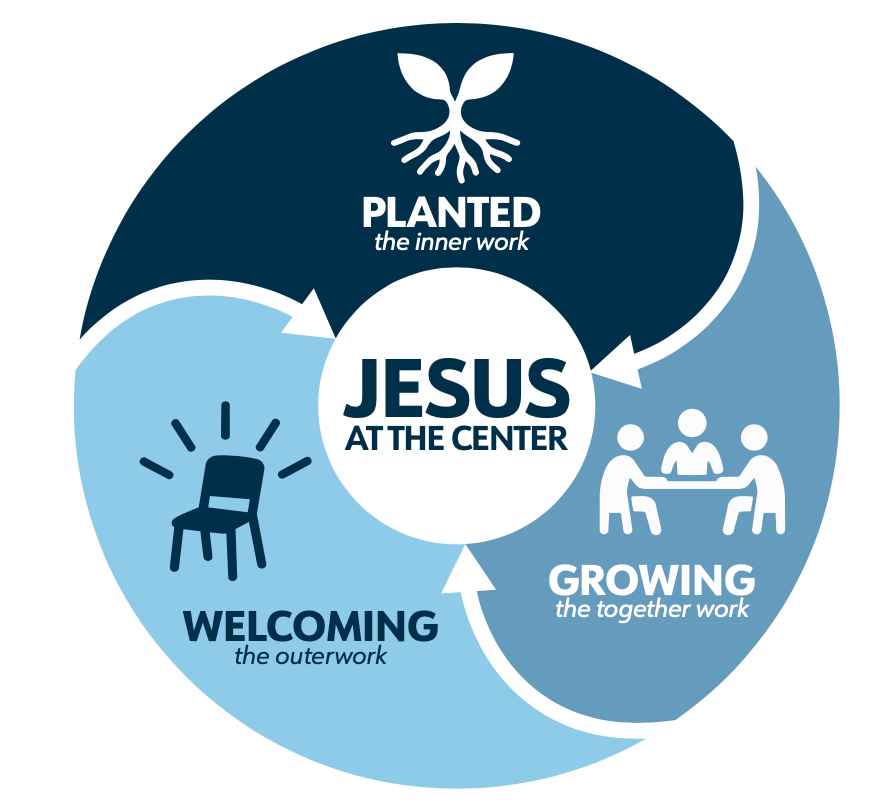
Being planted means learning to remain present, even when the excitement fades, and faithfulness feels ordinary. Growing means allowing God to address the things in us we’d rather avoid. Welcoming means moving toward people we might otherwise pass by.
None of those things requires a more impressive church calendar. They require us to become different kinds of people. That doesn’t happen simply because we show up for another event. It happens as we learn to recognize and respond to Jesus' invitations in the middle of our ordinary lives.
Sometimes that invitation looks like forgiveness.
Sometimes it looks like honesty.
Sometimes it looks like generosity.
Sometimes it looks like making room for somebody we don’t understand.
Sometimes it looks like putting down the very thing we’re so proud of accomplishing long enough to pay attention to what God is doing in us.
Dear Church, We Have Room to Grow
I love the church. I love what we can accomplish together. I love seeing people serve, ministries flourish, and communities changed. I’m not interested in abandoning the work of the church.
But I am increasingly convinced that we can become so consumed with doing the work of the church that we neglect the work of Jesus in us. That’s a dangerous place to be. Because a full calendar isn’t a formed life. A successful ministry isn’t necessarily a healthy one. Being busy for God isn’t the same thing as being available to him.
The question we need to ask isn’t, “What else should we be doing?”
It’s something more personal:
Where am I resisting the invitation of Jesus?
Is there a relationship that needs honesty or forgiveness?
Is there someone I’ve kept at a distance?
Am I participating in the life of the church while keeping my own heart carefully guarded?
Is there an act of generosity I’ve been postponing?
Or have I become so busy doing good things that I simply haven’t made room to listen?
I don’t know what the answer is for you. I’m still wrestling with it myself. I believe Jesus is inviting us to something more than a life filled with religious activity. He’s inviting us to his table. The beautiful thing about that invitation is that he welcomed us long before we had our lives together.
It’s time we let that grace change us. As we do the work of the church, let’s allow Jesus to do his work in us.
Jesus, help us recognize your invitation—and give us the willingness to respond.
There’s still room at the table.