

I need to be careful here because I am not writing this as an outsider throwing rocks at the church. I am a pastor. I have spent most of my adult life helping build the very thing I am about to criticize.
Somewhere along the way, many of us turned church into a religious product.
We didn’t mean to. At least, I don’t think we did. Most of us were trying to reach people. We wanted church to be a place where families felt welcome, children were safe, teenagers wanted to come back, and people could hear about Jesus in language they understood.
And a lot of good has come from that.
People have encountered God. Marriages have received help. Children have learned Scripture. Teenagers have found adults who cared enough to listen. Lonely people have found a place to belong. I have seen all of that happen, and I am grateful for it.
Still, we need to be honest about what else we created.
We built churches where the parking is easy, the coffee is hot, the children have fun, the music sounds good, and the sermon leaves people challenged—but hopefully not so challenged that they won’t come back next Sunday. We developed programs for every age and stage of life. We hired people to run them. We polished our language, clarified our values, upgraded our environments, and learned how to promote it all.
And, naturally, we made T-shirts.
None of those things is sinful. I like good coffee. I want children to enjoy church. I believe we should do our work well.
The trouble is not any one of those things. The trouble is what they begin to communicate when we put them all together. Whether we intend to or not, we can teach people that church exists to provide them with a dependable, meaningful, high-quality religious experience.
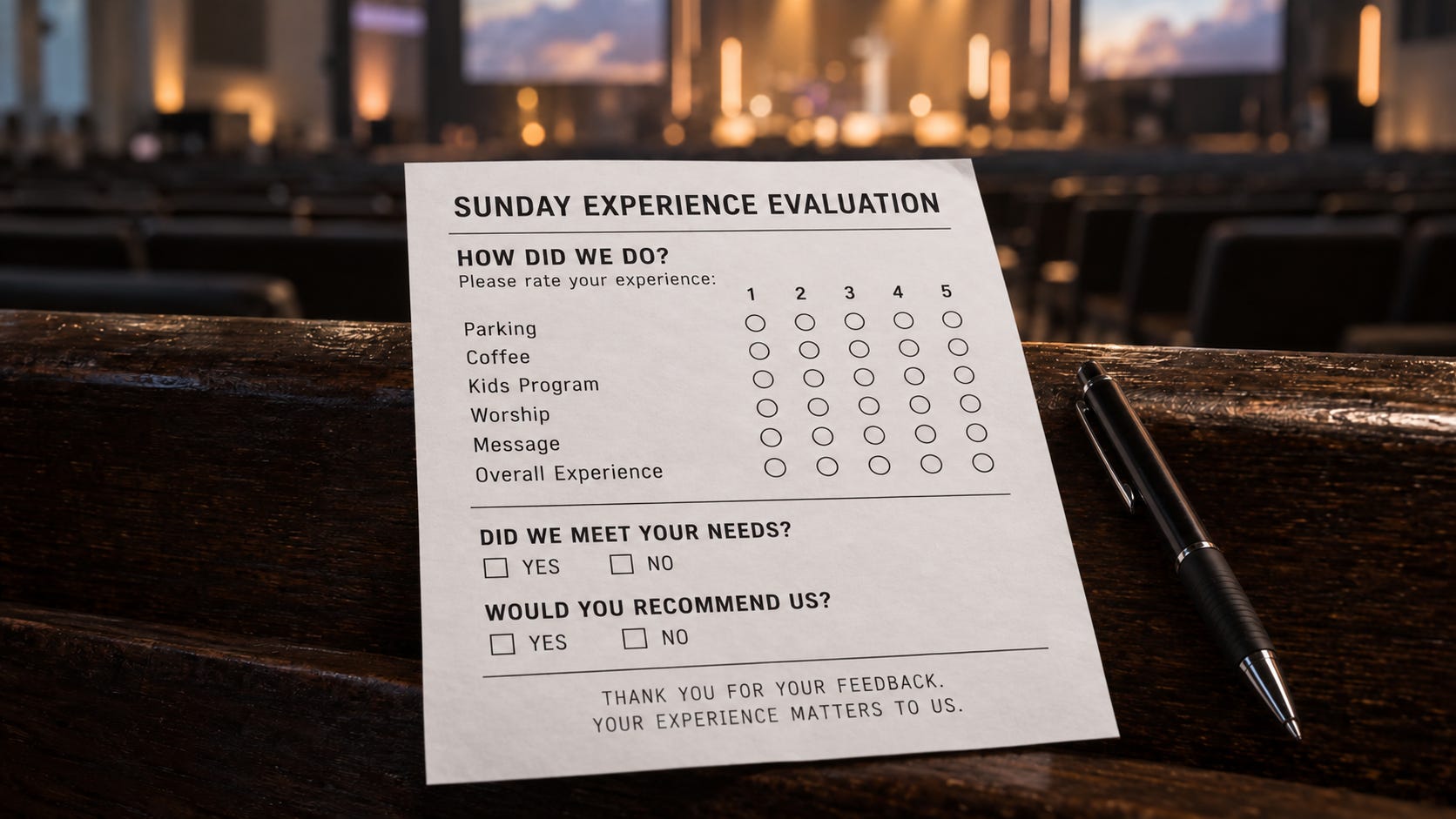
That message usually isn’t preached from the pulpit. It's built into the way we invite people. Come because your kids will love it. Come because your teenager won’t be bored. Come because the worship is powerful, the preaching is relevant, and there is something here for everyone in your family.
Then people arrive, settle in, and eventually begin evaluating the church by the same promises we used to attract them.
Do my kids still like it?
Am I being fed?
Do I enjoy the music?
Is this worth my time?
Could another church meet my needs better?
Pastors sometimes complain about those questions, but we should probably admit that we helped teach people to ask them. We appealed to consumer instincts to get people through the doors and then acted surprised when those instincts followed them inside.
People can feel that contradiction, even if they do not have words for it. We tell them, “We have something for you.” Later, we tell them, “This isn’t about you.”
Both statements may contain some truth, but together they create a strange kind of church life.
Henri Nouwen wrote about three temptations facing Christian leaders: the desire to be relevant, spectacular, and powerful. I wish I could say the modern church rejected those temptations. More often, I think we changed their names.
Relevance became reaching people.
Spectacle became excellence.
Power became influence.
Those words can describe good and faithful things. They can also cover up our anxious need to prove that what we are doing matters.
I know that anxiety. I know how easy it is to look at attendance, giving, online engagement, or the energy in a room and use those things to decide whether Sunday “worked.” I know the pressure to keep producing something people will come back for. I also know how difficult it can be to tell where pastoral care ends and customer service begins.
Eventually, everybody gets tired.
Pastors get tired of producing church every week. Staff members get tired of holding all the pieces together. Volunteers get tired of filling the holes necessary to keep everything running. The congregation gets tired too, because even the best experience must be topped eventually.
The room may be full, the music may be excellent, and everything may happen on time—and yet something can still feel thin.
Maybe what is missing is not another program. Maybe it is the shared life of the church. Sometimes, well-meaning religious folk call this the “presence of God.” But it isn’t God’s presence that’s missing— at least, not in a religious sense.
When I read the New Testament, I do not see professionals delivering a religious experience to an audience. I see a body. I see people eating together, carrying one another’s burdens, sharing what they have, confessing their sins, practicing hospitality, forgiving each other, and learning—usually imperfectly—how to live under the lordship of Jesus. And this is more normal and frequent in their lives than anything else.
I see people who actually need one another.
That kind of life cannot be produced from a stage. The stage can teach us. It can call us toward faithfulness. It can give us language for what God is doing among us. But it cannot live the Christian life for us.
The church has to become flesh somewhere. And this flesh lives and breathes every day, not just in the 75 minutes reserved for the Sunday show.
It has to show up at the dinner table, in the hospital waiting room, during the uncomfortable conversation, and in the long season when someone has nothing impressive to offer. It looks like being known well enough that people can tell when you are not okay. It looks like staying when leaving would be easier.
Incarnation, if you want to get specific.
That is why the church’s branding problem cannot be fixed with a new logo, a better slogan, or marketing that uses the word “authentic” more often. The deeper issue is the promise underneath the whole thing.
Come here, and we will give you the kind of church experience you have been looking for.
But Jesus' invitation is different.
Come and follow me.
Come and be known.
Come receive grace, and then learn how to give your life away.
Come belong to people you probably would not have chosen for yourself.
Come die—and discover that this is where real life begins.
The first invitation may help us gather a crowd.
Only the second can form us into a church.